
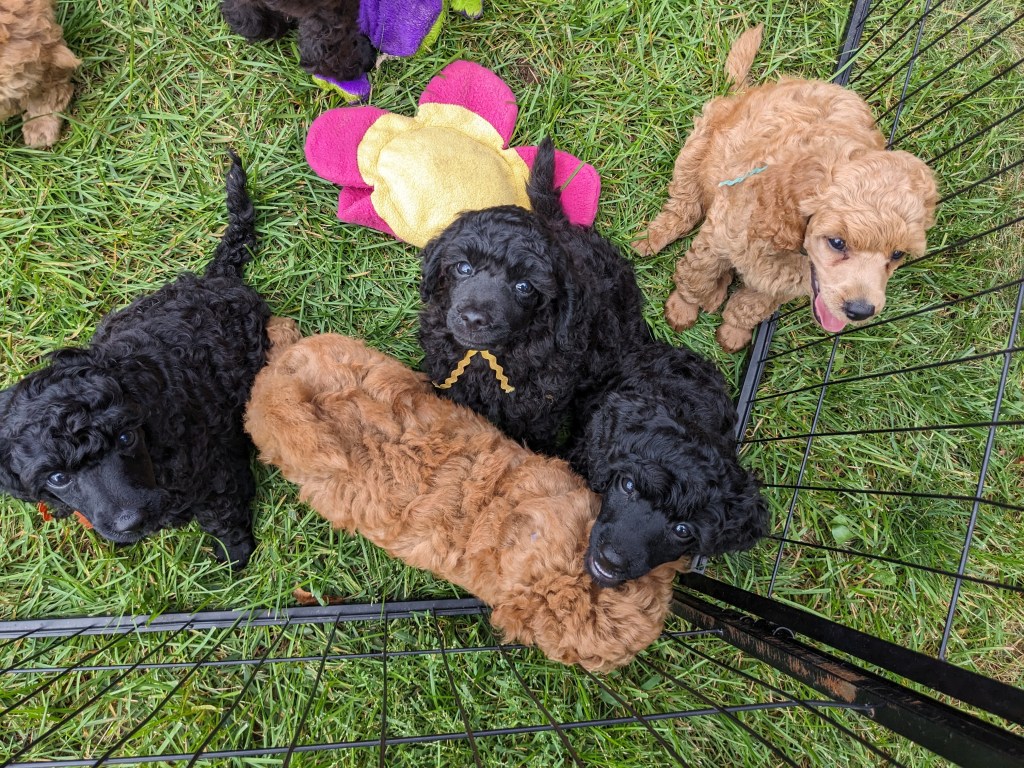
The term ‘service dog’ (aka ‘assistance dog’) has become very popular in recent years, particularly with more people embarking on the journey of owner-training – acquiring a service dog prospect which they will personally raise and train for their specific medical needs. Let’s take a closer look at what a service dog is, what is required of them, and the role of a breeder in this process.
This intro paragraph is from a detailed article I wrote in 2021 titled “Considerations for Selecting a Pup as a Service Dog Prospect” for the BetterBred blog. I’d like to share an excerpt here – please check out the full article through the link at the bottom of this post.
Different Disabilities, Different Working Roles
There are a variety of roles an assistance dog may perform based on their handler’s needs, and this can have an impact on what type of characteristics the dog should have.
- A guide dog needs to have the confidence to take charge and lead their partner, taking many of their cues from the environment (stopping at curbs, going around obstacles), and also needs to have ‘intelligent disobedience’ which is when they ignore the handler’s cue because the response would be unsafe – perhaps a bicyclist is approaching, or there is construction or spilled trash that needs to be avoided; they are typically large enough to lead from a harness while still having hips/flank within touching space of their handler, and they typically need to be raised from puppyhood in part to avoid habits that could be challenging for a blind handler to notice.
- A hearing dog needs to be very alert to the environment and good at pinpointing sounds, with the energy and enthusiasm to respond happily even through the night; they are often smaller sized and can often be found in the shelter – the high energy, social dog who wants to explore everything around them is a challenging pet and often ends-up relinquished to a shelter.
- A service dog for mobility needs to be calm, handler-focused, content to just follow along like a shadow until assistance is needed; they still need confidence but not in the ‘taking charge’ sense that a guide dog has; the size can vary greatly based on the handler’s task needs, but overall energy is on the lower side and the dog prefers to observe rather than participate when there is fun in the environment; again, raising from puppy-hood is usually best, in order to avoid challenging habits but also because it is very difficult to find an adult dog of the proper temperament – this is a sweet, easy dog, not one that an owner is likely to give up.
- A service dog for a detection/alert/response type role needs a careful balance of handler focus and environmental focus, based on the scent/s they need to respond to – a scent from the handler (such as low blood sugar, on-coming seizure or cardiac/anxiety episode) vs a scent in the environment such as presence of an allergen; some handlers also need a dog to provide certain guiding tasks as well, such as leading them out of a building while handler is in an altered mental state; size and energy and focus needs vary greatly, so puppy-raising vs ability to find in a shelter also vary.
- A psychiatric service dog follows a similar range of potential characteristics as the above detection/alert/response roles, with the added caveat that the dog can not have instincts that become anxious or protective responses when the handler is anxious or otherwise out of touch with the world around them. This is one of the most challenging roles to successfully match, because the dog needs to both be very in-tune with their partner yet not allow the partner’s emotional state to impact the dog’s feelings for the situation. Additionally, many dogs don’t transfer well from a trainer to a partner needing psych support, but many dogs also have trouble developing their own confidence for public access if raised by a partner who is not confident in those environments. A custom acquisition and training plan is best for this role, finding a careful balance for the needs of each partner as an individual. [This paragraph is not included in the original article, which did not discuss psychiatric service roles.]
In the full article I also define the legal side of what qualifies a service dog and their partner, as well as discussing the differences between getting a program-trained dog, getting a privately-trained dog (or choosing a board and train option), and owner-training a dog for one’s self.
Here is the link to Part 1 of my article as posted on BetterBred: https://www.betterbred.com/2021/12/06/considerations-for-selecting-a-pup-as-a-service-dog-prospect-part-1-introduction-to-service-dogs/
I will share an excerpt and link to Part 2 of my original article another day.
To access the full article you will need to create a free account at BetterBred.com, which will give you access to a very large blog primarily focused on the topic of genetic diversity in the canine species, with a significant number of articles on other fascinating side-topics. BetterBred is the company I use to help analyze the true genetic diversity of my dogs and to plan most of my pairings.


 APAW - Poodle Pups for Working Roles
Leave a reply to generouslyad47801177 Cancel reply