
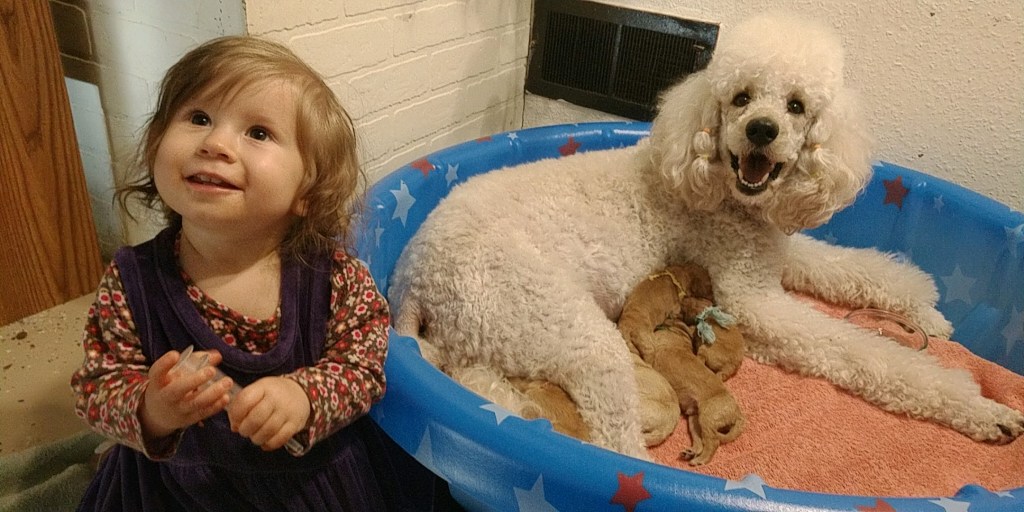
“What number am I on your puppy waiting list?” This is a question I am frequently asked.
There are many breeders whose answer is as simple as a number referring to the order in which deposits are received – if you were the first to pay, you get the first pick of any available puppy; the second to pay gets their pick of any puppy after you, etc.
Some breeders make their list practically a status symbol, where the picking order determines the cost of the puppy – 1st pick is $6,000; 2nd pick is $5,000; the rest of the pups are $4,000 etc. Yes, these are actual numbers I’ve seen, and yes I’ve also seen puppy prices much higher than this… up to around $20,000 for a “pick of the litter”… you’ve probably already guessed it, but these costs and wait-list styles are primarily from breeders who are focusing on the ‘designer’ aspect, generally breeding off-colors and improper coat-types for their breed/mix, and often not doing the health testing recommended for their breed/s. Many of these breeders don’t even seem to screen their homes, as some websites allow anyone to send a PayPal payment to automatically add themselves to the list. Puppy producers like this are often referred to as ‘greeders’.
This concept is terrifying to me and every ethical breeder. Part of what makes a breeder ethical is our care in selecting proper homes for every one of our puppies, not only in making sure each new owner is a wonderful dog home, but also in only allowing them to bring home a pup that has assessed well for their home and lifestyle intended… not the one with their favorite color.

So no, you won’t get a number or any other simple answer when you ask where you are on my waiting list. I do have a general order based on when people get on the list, and the longer a home is on the list the higher they will get as the homes before them get matched to puppies… but the 15th person on my list could easily end-up with their perfect pup in my next litter if the pup was not the right match for the other 14 waiting homes.
I aim to keep a diverse waiting list where I have many homes whose ideal puppy looks different – some wanting an active working partner and others wanting a snuggle-buddy, some wanting handler focus for service tasks and others wanting outgoing social interest for therapy work, some wanting high prey drive for hunting and others wanting a dog that will be reliable loose on their farm. This allows me to assess each puppy and determine what their natural tendencies and aptitudes are, and to match them to the home who’s needs and desires are the best fit.
For each litter, I first assess pups for the working homes on my waiting list – the service dog homes, search and rescue homes, high-level performance sport homes, etc. These roles need the most careful combinations of traits and often it’s just as important to lack certain traits as it is to have others. These matches are assessed starting at the top of my waiting list, but if the pup doesn’t have the right combination of all of a working home’s needs then I continue looking down the list. For example, I may have 2 pups who assess beautifully for service work, but both are way too small for the person at the top of my list for a service prospect; that person will be given the option of shifting to a smaller dog knowing it may change what tasks they can ultimately request of the dog, or they can remain at the top of the list for hopefully a larger prospect from the next litter; meanwhile the current pups get matched to the next service homes down the list who are better fits for their size.
How can I give “top” priority to multiple types of working homes? Because each role will have a different “perfect” puppy. A handler seeking a search and rescue dog will need a separate set of characteristics including high search drive, intense confidence, a very strong inclination to use their nose to solve problems, and the desire to follow their goals despite a person accidentally pulling them off-scent. A top agility prospect will look similar in many ways except it doesn’t matter if they use their nose but they do need to follow their handler’s directions and not make their own course!
After matching all of the top working candidates with the homes on my list, I work my way from the top of the list down, matching pups according to needs. Maybe I have two therapy homes and a family seeking a companion for young children. Therapy dogs should be outgoing with strangers; the dog’s level of physical sensitivity will determine what therapy settings they are most easily suited for though generally any can be managed with training and maturity… for nursing homes and certain hospital wards the dog should be very physically gentle; for reading programs with kids the dog should settle quickly without sudden movements; for de-escalation in a high school they should be more physically and emotionally resilient and enjoy rougher and louder interactions. Meanwhile the family pet with young children does not need to be particularly outgoing, but they should be a gentle follower-type dog within their family structure, naturally more likely to roll over for belly rubs than to jump up and knock a kid over.

Any homes that don’t find the right pup in one litter will end-up closer to the top of the list for the next litter. Not only this, but as I plan my upcoming litters I take into account the needs of the people still on my waiting list. If I have people who need a bigger dog, I make sure an upcoming litter is likely to produce at least a few bigger dogs; if I have a bunch of people who prefer a lighter-colored dog I will shift the order of my planned litters around so that we get lighter pups soon.
Ultimately I only pair parents together when I want to keep a pup of that combination to continue my lines in that direction, but I don’t have a strong need for specific timing of each pairing – I can delay the litter that will be high-energy if I have more homes waiting for calmer service dogs and companions.
How long might a home need to wait? I try to keep the wait within 6-12 months, which generally means each home will be matched to their puppy in 1-3 litters from the time they get on my list. If more homes are on my list I will add in an additional litter that I had been planning further into the future rather than letting the waiting list get very long. I also encourage people to get on the list before they are ready, which allows their name to rise to the top – a home can always defer to a future litter if the timing just isn’t right, and they will hold their spot at the top of the list for high matching priority when they are ready to say ‘yes’.
In situations where I am not likely to produce what a home is seeking, I will steer them towards other breeders who are more likely to produce what they need. Generally I will have steered those homes away without putting them on my wait list in the first place, but sometimes it’s an unexpected change – perhaps they want a particularly large dog and the large dog I intend to breed either doesn’t get pregnant, or develops a health condition and needs to be retired without the planned litter.
On the subject of deposits – common practice amongst breeders is that homes are placed on a breeder’s waiting list after a non-refundable deposit is submitted. At this time I do not require a deposit to be added to my waiting list, but I do require a $500 deposit to ‘hold your spot’ for a specific litter by the time the pups are about 1 week old. This is so that I know how many homes I have who are committed to a pup from that litter and I can line up any additional homes needed to be sure every pup will have a great match ready when they reach the age to be placed. Note – a deposit does not reserve a specific puppy unless they are already old enough to be matched by temperament.
I do accept deposits prior to pregnancy/birth if a home is flexible on the parents; as we are experiencing currently, sometimes litter plans need to be shifted and sometimes matings don’t result in pregancy, or we don’t get a specific gender or color or other preferences/needs a home may have. If a home is very definite on what they are seeking then I encourage them to remain on my waiting list but not send in a deposit until I’m fairly certain I will/have the right pup for them. The more flexible a home is, the shorter their wait is likely to be even if they only just got on the waiting list. When a deposit is received, the home automatically jumps up my waiting list, landing behind other homes who have already sent a deposit.
** Deposits are applied towards the cost of the puppy. They are generally non-refundable (reasonable exceptions apply); the intent of the deposit is to assure me that a home is serious about getting a pup, which means that I will be turning away other potential homes under the assumption that the pup is spoken for. If a home chooses to leave my waiting list just prior to placement then I may need to keep the pup longer while searching for the right home again; the deposit helps to cover the additional food, vetting and time I will be spending. The main reason I wait until pups are on the ground before requesting a deposit is to give homes full ability to avoid sending in a deposit if they know the timing/parents/colors/genders/etc are unlikely to fit what they are seeking, and letting me know from an earlier stage how many pups genuinely are spoken for. If a home has a change in circumstances and chooses to wait for a future puppy then the full deposit remains in their name to be used towards the future pup.
Are you looking to get a Poodle pup this year?
Fill out my application form!


 APAW - Poodle Pups for Working Roles
Leave a reply to NE Damm Cancel reply