
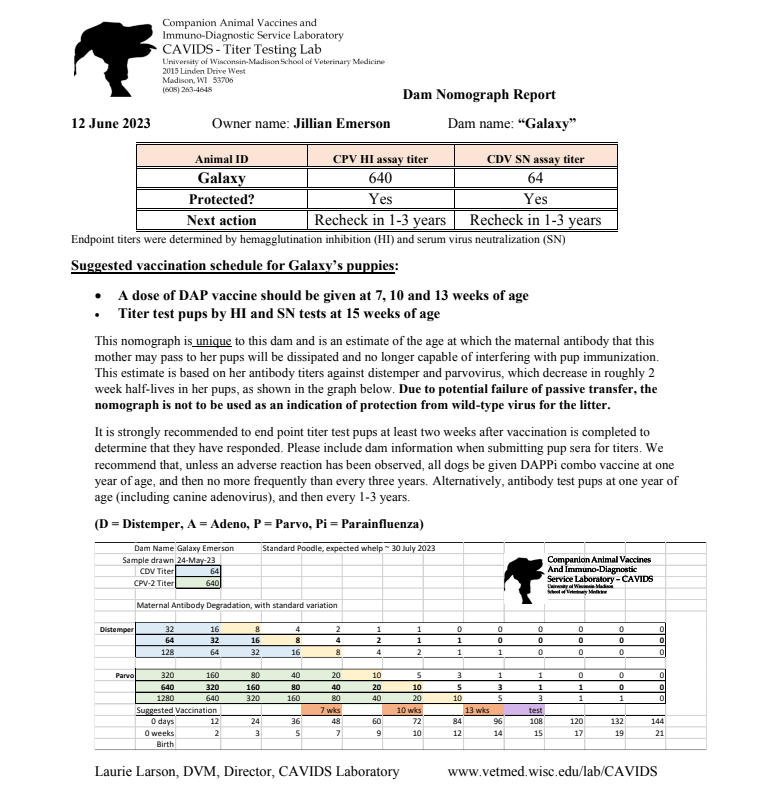
Here is Galaxy’s nomograph report, which was determined by running a titer test on her blood. The lab analyzed what protection levels she personally has against the two core diseases we want to be sure her puppies are protected from – parvo and distemper – and then used her specific titer values to each disease to come up with a customized time-line for when her puppies (the V litter) are best served for receiving their puppy vaccination/s.
Did you know that only a single vaccination is needed for a dog to become fully protected against these diseases?
Vaccination with attenuated live canine parvovirus (CPV) and canine distemper virus (CDV) vaccines in the absence of MDA [maternally derived antibodies] can result in protective immune responses within 3 days of a single injection, which may be followed by immunity that lasts many years, if not for life.
https://www.ncbi.nlm.nih.gov/pmc/articles/PMC7152223/#:~:text=Vaccination%20with%20attenuated%20live%20canine,years%2C%20if%20not%20for%20life.
The only reason there is generally a “series” of puppy vaccinations is because the maternal antibodies are passed through the dam’s colostrum, giving the puppies temporary immunity to the diseases – but also ‘protecting’ them from the immunizing benefits of the vaccination itself!
Vaccination vs Immunization
Timing of Vaccination
When the vaccination is given too soon, it will not provide immunization for the puppy but the pup is still exposed to the potential risks that come with vaccination – the potential short-term side effects like seizures, fever or death, as well as the potential long-term side-effects such as triggering an autoimmune disease.
When you wait too long to vaccinate (or provide another form of immunization to boost antibodies), the pup spends time at-risk for acquiring the disease which exists all over the environment… in the soil, on shoes, passed on from other dogs and wild-life, etc. Immunity generally lasts for life, so it is rare to see an adult dog who is actually ‘sick’, but they can carry and spread the germs just the same.
As a result, most vets follow a protocol of giving 3-4 rounds of puppy shots, spread apart by 2-4 weeks. Often the first shot is given around 8 weeks old, shortly before the puppies leave their breeder to venture out into new homes and environments. The following shots are often given at 12 weeks and 16 weeks… however this does not always provide coverage because research has proven that maternal protection can last to around 18 weeks old – meaning no vaccine prior to that time will have provided the intended immunity!
A nomograph is our best option currently to determine when to expect each litter to be ready for vaccination.
Technically it would be even more accurate to test each individual puppy, but testing the dam is cheaper, safer (less exposure for pups), and you can have results well in advance of potentially needing to give the first vaccination.
Notice how Galaxy’s pups will lose her protection to distemper by around 7 weeks old – a single vaccination provided at 7+ weeks old could (should) protect them for life against this disease.
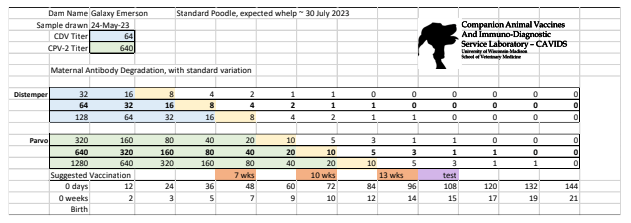
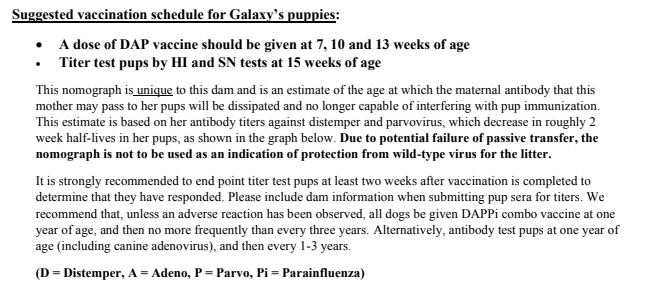
However, notice that at 7 weeks all of her puppies will still have her full protection against parvo so the 7 week vaccination will mean nothing for that disease. Since we don’t want to wait too long when some pups might have lost protection a little faster than expected, the recommendation is to vaccinate for parvo again around 10 weeks old when perhaps half of the litter will be ready to receive vaccine immunity… but there will still likely be a few pups protected by mom, so a final vaccination is recommended for each pup around 13 weeks old by which time they should no longer have any maternal antibodies.
Puppies can have their own titer tested 2 weeks after their final vaccination to verify that they truly have built their own immunity.
Galaxy’s nomograph indicates that her pups should begin their vaccinations earlier than many litters (for distemper protection), and also that they will be fully protected at an earlier age, which in turn means that early socialization will have fewer risks. [By comparison, my other litters have been recommended for first vaccination at 8-9 weeks old, and some have been recommended for a final vaccination as late as 17 weeks old.]
My Choice of Vaccination Protocol
The first puppy shot I give covers only distemper and parvo – Nobivac Puppy-DPv.
For the next shot or two I recommend a 5-way shot which also covers for a few other diseases; I never recommend more than that at once – if more diseases are desired to be vaccinated against (such as lepto, lyme, bordetella, etc) research indicates there is better immunity when separating the shots out by at least 2 weeks – this gives the body time to focus on fewer ‘attacks’, which results in stronger immunity to each disease.
Rabies vaccinations are required by law in the US, but each state has their own legal requirements. In my state of Massachusetts, the first rabies shot is due by 6 months old, then an update within 1 year, followed by every 3 years for life.

For anyone wondering, Galaxy only received her puppy series of vaccinations, (in addition to rabies vaccinations) which were completed about 6.5 years prior to this round of titers for her; she still has plenty of protection from these diseases.
Standard Poodles have higher risk of a variety of diseases which are known to be triggered by over-vaccination, so I choose to play it safe and vaccinate a minimal amount that maintains the protection we want to see.
Interestingly, very few vets are aware of nomographs as of yet. The CAVIDS website has tons of information available to anyone, but geared towards explaining nomographs to your vet so that they will understand why this is more accurate than following their usual ‘generic puppy vaccination protocol’.
Cost of Titers/Nomographs
Titer testing is more expensive than getting a vaccination, but not by much, and it is significantly safer in addition to providing valuable information. Current charges for vaccination tend to be around $30/each (in Massachusetts, US). Instead, I have my vet clinic draw blood and spin it down to give me a tube of serum (about $50); I then mail it and pay the lab directly ($45 for both parvo and distemper titer or nomograph). There are many labs to choose from for running titers, and most charge around $30-60 depending on which diseases you want analyzed. The lab of choice for vets in my area charges multiple hundreds of dollars, which the vet then marks up – so if cost matters to you, take the extra step to select the lab of your choice and to mail the serum sample yourself. Many universities offer this service around the country, as well as various companies such as HemoPet.
Additional Resources
VIDEO: CAVIDS’ Dr. Larson explaining Nomographs and Puppy Follow-Up
Vaccination Interview with Dr. Ronald Schultz (May 2013)
DogsNaturally; What Every Vet Should Know About Vaccines (Feb 2022)
Canine Distemper in Depth and the Vaccines, by Dr. Jean Dodds (Dec 2023)


 APAW - Poodle Pups for Working Roles
Leave a reply to Jillian Emerson Cancel reply