
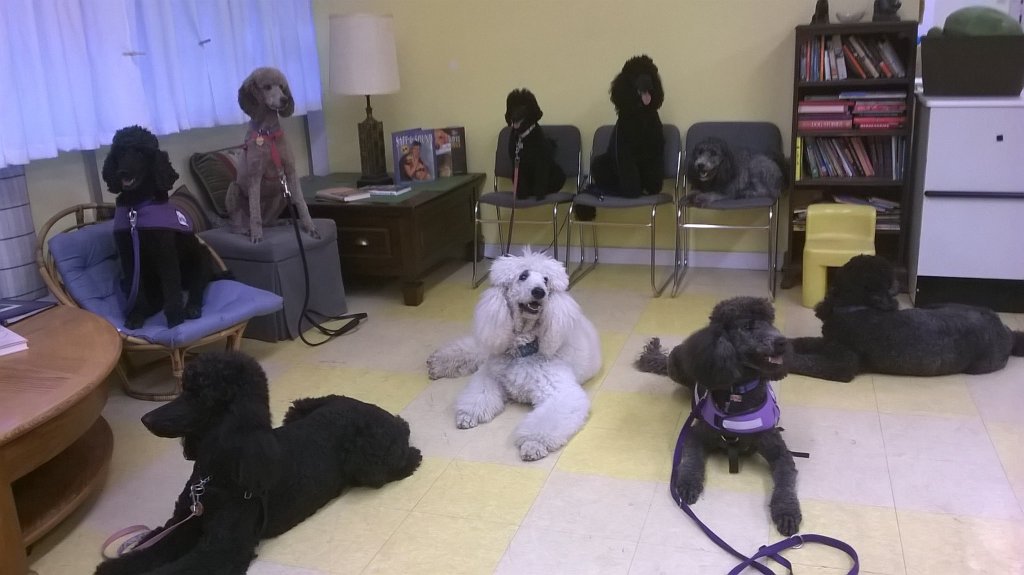
This is a super common question and it can be hard to figure out exactly what the differences are, and which best fits what you are looking for… and for which you even legally qualify.
[This post is written for residents of the US.]
Let’s start by painting a picture of what you might want.
A friend, a companion, a dog who enjoys being with you and partaking in life’s adventures together. You want a dog who walks nicely at your side, doesn’t bark at other people or dogs, and is happy to follow your cues in exchange for a “good pup”, a pat on the head, and an occasional treat. You want a dog that snuggles you when you are lonely, and plays with you when you pull the ball out – maybe you even want them to throw the ball on your lap when you are depressed and need to be encouraged to get up and do something. Whatever life looks like, it will be better just because your wonderful dog is there with you. This is a pet, and it’s why so many people have loved dogs for thousands of years – you don’t need to be disabled or ask for any special designations to have this relationship. All you need is to find a dog who has a compatible temperament to be a good companion for you, and a bit of basic training for general good behavior.

Emotional Support Animal/Dog
Now let’s say you want this type of relationship but you rent and your landlord doesn’t allow pet dogs – this is where the Emotional Support Animal (ESA) or Emotional Support Dog (ESD) designation comes in. It’s when you want a dog as your companion *and you aren’t allowed to have one* due to housing policies.
To qualify for an exception to a no-pet policy you would ask your landlord for a ‘reasonable accommodation’, and to do so you need to be legally disabled under the Americans with Disabilities Act. Feeling lonely or having some anxiety isn’t enough – your symptom/s need to be severe enough as to be considered legally disabling.
[Under the ADA] a person with a disability is someone who:
- has a physical or mental impairment that substantially limits one or more major life activities,
- has a history or record of such an impairment (such as cancer that is in remission), or
- is perceived by others as having such an impairment (such as a person who has scars from a severe burn).
Major life activities are the kind of activities that you do every day, including your body’s own internal processes. There are many major life activities in addition to the examples listed here. Some examples include:
https://www.ada.gov/topics/intro-to-ada/
- Actions like eating, sleeping, speaking, and breathing
- Movements like walking, standing, lifting, and bending
- Cognitive functions like thinking and concentrating
- Sensory functions like seeing and hearing
- Tasks like working, reading, learning, and communicating
- The operation of major bodily functions like circulation, reproduction, and individual organs
If you are only seeking accommodations for a dog for emotional support/companionship (and not a service dog trained in tasks to mitigate your disability) then there is an additional stipulation that the role the ESA provides must be disability-related; in other words, your disability needs to be one where your disabling symptoms are improved by the presence of the dog… being disabled by a broken back does not qualify for having an ESA, but if there is also disabling depression then an ESA becomes a reasonable accommodation.
Once you have asked for a reasonable accommodation in the form of an ESA, you will need to provide the landlord with a letter from a medical professional with whom you share an ongoing treatment relationship regarding your disabling condition, and who believes that the presence of an animal companion will improve at least one symptom of your disability. The letter needs to share in what way/s the presence of an ESA will mitigate your symptoms, but it does not need to identify your specific diagnosis or go into details about the symptoms – that said, the more specific information you are comfortable including can make your need for the ESA more clear and therefore more likely to be approved for the accommodation.

Where/how to acquire your ESA?
Your best bet is to go to a breeder to find a pup showing the characteristics you are seeking in your companion, or if getting an adult is better you can go to a shelter or rescue group to adopt an adult dog that has already matured into the type of dog you are looking for. A retired show or breeding dog from a reputable breeder is another excellent choice. Pups from unknown origins/genetics are a bit riskier but still totally viable options. Pretty much any dog you come across who feels like a good match for you is suitable – with the caveat that the dog will need to maintain proper manners and habits or you will risk them losing the accommodation as an ESA.
When do they become an ESA?
The moment you become their owner, assuming you qualify for having an ESA. There is no training, no temperament screening, no health assessment – nothing. Any living creature which by their mere presence provides emotional support to mitigate an aspect of your disability, is by definition an Emotional Support Animal.
Psychiatric Service Dogs
Now perhaps this companionship isn’t the extent of what you want from your dog – maybe you envision your dog actively performing trained behaviors to help get you through your bad days. Maybe you see tasks such as bringing you your medication when you are too sick to get up and retrieve the meds yourself; laying on your legs to provide Deep Pressure Therapy to regulate your blood pressure or release hormones to combat negative emotions; guiding you out of a crowded aisle or back to an exit during a panic attack, etc. If you are looking for any number of trained tasks such as these *and* you want your dog to have public access to come with you nearly everywhere you go, then you are best suited to getting a Service Dog; the role can be further defined as a Psychiatric Service Dog if your disability/ies is classified as a psychiatric condition.
If the role your dog will have is as a trained Service Dog then you still need to ask your landlord for reasonable accommodations, but you generally do not need to provide any documentation; however, having a letter of support from your medical professional and/or any type of training verification could help make the approval process smooth. (Examples of training verification could be certification from a specific program, a letter of support from a trainer who has assessed you and your dog as a working team, your own personal training records, etc.)
Where/how to acquire your Psychiatric Service Dog?
This requires much more screening than for a pet or ESA; the best sources will be a program-trained dog who already meets the qualifying criteria, or if you have the time/resources/ability to train the dog yourself then a very carefully selected puppy will be your next best bet, or an amazing young adult dog found with plenty of good luck.
When do they become a Psychiatric Service Dog?
Legally, this is when they meet the minimum requirements to qualify as your Service Dog under the ADA. Generally this will mean they are a mature dog, with reliable basic training and public manners, and with at least one reliable task specifically trained to directly mitigate an aspect of your disability. In reality, a Service Dog typically is taught much more than one task (15, 30, or even 60+ tasks are typical, based on the partner’s disabilities). It is also good practice to verify that a Service Dog has good health including sound hips and elbows, clear eyes, strong heart, reliable digestive system, healthy skin and coat, and any other conditions which their breed/s are predisposed towards. Depending on your state laws, a Service Dog in-training may be covered legally the same as a fully-trained dog.

An important note – you can train your pet dog or your ESA to perform all of the same tasks that you might teach your Service Dog! The difference is that your pet or ESA can only accompany you to public locations which allow pets or which have invited your dog specifically – they are not legally covered for public access under the ADA.
Here are a few other points I want to briefly address:
- Many people try to get ESA or Service Dog housing accommodations as a way to avoid pet fees or to get around policies that limit breed or size of dog – please don’t do this as it makes landlords suspicious of everyone; use this reasonable accommodation as it was intended, and be a responsible dog owner and neighbor to show that you are grateful for the accommodation (and, you know, just to be a decent person).
- Even if your ESA or Service Dog accommodation is approved, the landlord may revoke permission at any time if the dog becomes a danger, nuisance or causes destruction to the property. You need to actively be a responsible owner and provide the training, socialization, crating, etc that your dog needs for being a good tenant, or provide for other means or responsible care such as taking your dog to day care while you are gone at work.
- If you already have a pet dog which doesn’t meet the breed/size policy of a housing unit you are hoping to move to, try asking the landlord what you can do to be granted an exception for your pet. Some examples include earning a CGC (Canine Good Citizen certificate, which demonstrates basic good manners and general nice demeanor towards people and being polite around other dogs), or completing some other proof of training/nice temperament; in some cases even just arranging an introduction with the landlord to let them assess the dog themself could be enough, especially for a short-term lease. Not all landlords are open to making exceptions, and if their requirements are tied to the stipulations in their insurance policy then you are out of luck.
- Don’t buy a letter online from some ‘doctor’ willing to sign anything for a bit of cash; your letter is meant to come from a professional who has a history with you, can vouch accurately for your needs, and continues to see you for on-going support/treatment.
- As above, don’t waste your money on online “certifications” – these are essentially all scams, and while some of them look flashy they are unnecessary and create issues for all the legitimate owners/teams who know to avoid them.
- Small, privately owned housing is not covered under the Fair Housing Act. Not every landlord needs to approve your request for reasonable accommodation, even if it’s fully legitimate and you’ve got all the proper documentation.
- Emotional Support Animals/Dogs and even Service Dogs being welcome on airlines is a separate matter and is addressed by the Air Carrier Access Act (ACAA); the ADA (for Service Dogs) does not apply to airlines/in the air, and the FHA (for ESA’s) is only in relation to your housing unit. It is important to understand that there has been a lot of abuse of the leniency that the ACAA attempted to offer owners with ESA’s, and as a result policies have become more strict and may eventually be eliminated altogether; most Service Dogs are classified separately under the ACAA and are not required to provide excess documentation, but due to too many owners claiming under-trained or under-socialized dogs as Psychiatric Service Dogs, the ACAA currently does require all owners of Psych SD’s to submit additional documentation for flight approval. Again – please don’t try to get this privilege if you/your dog don’t legitimately qualify, or if you do qualify but your dog isn’t trained and socialized to be a good passenger in such a hectic environment. If you need to fly with your pet, they should be flying in cargo unless small enough to remain in a carrier under your seat. I know it’s not fun and it adds a significant expense, but trying to squeeze into a different category hurts everyone else who those rules were actually designed for.

Additional Resources
Here are some great resources for further information regarding ESA’s and Service Dogs in regards to housing:
Massachusetts Details for Housing Accommodations for Service Dog or ESA
HUD Guidelines for Assistance Animals
Sample Letter for an ESA as offered by HUD (Word doc)


 APAW - Poodle Pups for Working Roles
Leave a reply to Jillian Emerson Cancel reply