
While training your dog it is easy to feel like there should be constant (or at least regular) improvements in the areas you focus on teaching.
When the dog seems to be stuck at a certain point, or especially when they seem to ‘forget’ and need more help than they needed the other day, it can feel really frustrating.
Don’t stress! These ups and downs are a normal part of learning, and it doesn’t mean anything is wrong.
Help the dog where they are at, keep them motivated, and in the next session or two they will probably be right up to where they had been – if not better!
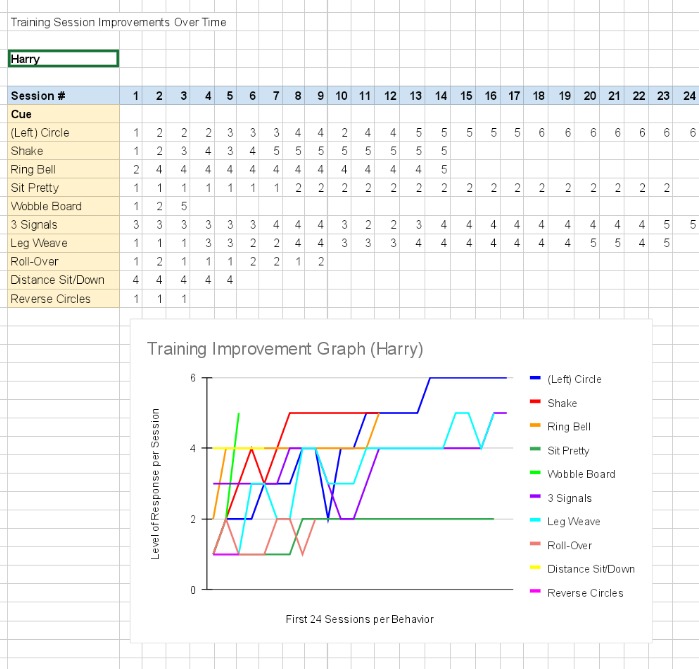
This chart is made from the data of Harry’s training records I’ve been keeping these past 4 weeks [early 2023]. I selected ten behaviors that demonstrate a wide range of difficulty to him, from super easy based on what he already knew at the time I introduced the new behavior, to behaviors that are challenging either physically or intellectually for him.
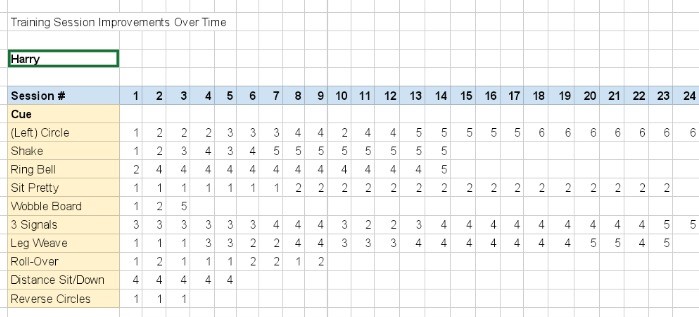
I assigned a number value to his levels of response (lure = 1, combo of lure and target = 2… verbal = 5, and ability to respond to both verbal and signal on their own = 6). Not every behavior has been worked on every day, so this chart isn’t accurate as a timeline, but rather how many sessions into working on each behavior. They all start at the far left, though in reality some of these behaviors I’ve only introduced this past week, meaning his knowledge base was much more advanced prior to his first session.
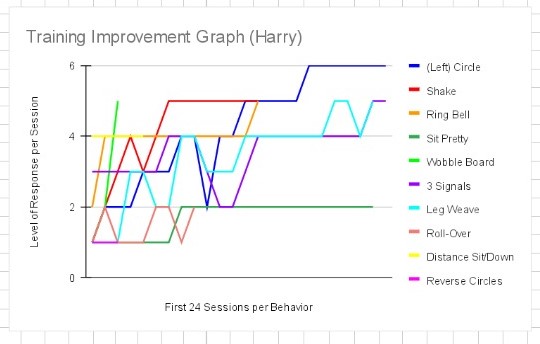
Some of these behaviors do demonstrate a linear path of improvement – notably (Left) Circle and Shake; Harry overall showed same or improved understanding with each session. But notice in particular the 3 Signals and Leg Weave behaviors; they’ve been up and down all over the place – still demonstrating an overall incline over the course of 20+ training sessions, but a significant amount of needing to step back and work at simpler levels or returning to using food as a lure to build motivation and persistence.
Now take a look at that long green line that shows very little improvement over many sessions. That could indicate that the dog is having trouble understanding the behavior, and that it should be broken down into smaller steps, or a new training method could be approached, etc. In this case, the behavior is Sit Pretty, which requires building muscle and balance which means it should be expected to go slowly. He actually is making very good improvements in that skill, but it would need to be graphed at a different scale to show that.
Keeping training records is helpful for so many reasons – this post demonstrates how you can use your records to look at the big picture and see just how far you and your dog have come with individual behaviors and as a whole.
APAW homes have access to the training record sheets that Jillian has designed and tweaked over the years. We have detailed yet simple weekly records available in a range of topics, categorized by age (listing only behaviors typical/appropriate to introduce at each stage as well as other topics important to cover in that stage of development, such as car manners and meeting strangers, etc); we also have records custom to specific training focuses (service, therapy, tricks, agility, etc).
These record sheets store all of the data needed to pull out the numbers and create graphs such as the one demonstrated in this post.


Leave a Reply