
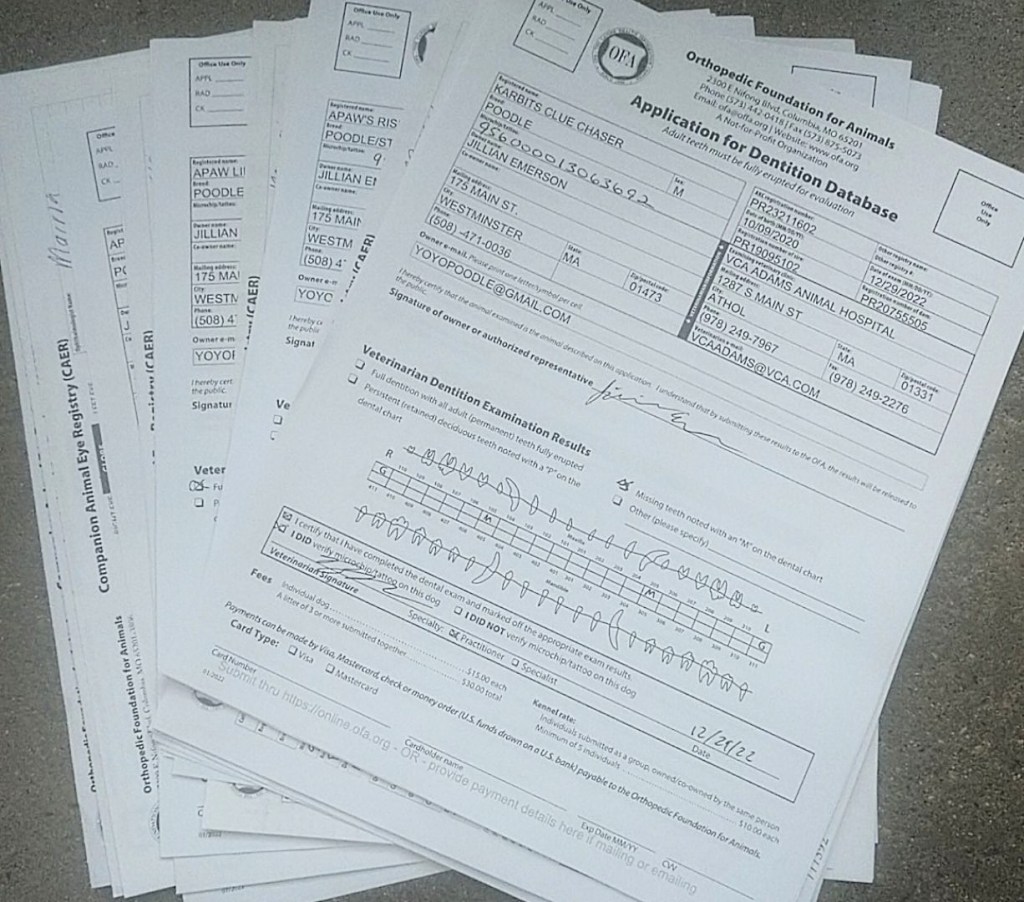
Health testing is very important to us and our breeding dogs are all tested well beyond the minimum requirements for receiving their CHIC numbers from OFA. You can find health results published on OFA for many dogs produced by APAW; historically we’ve kept around half of each litter through maturity and completed hips/elbows/heart/eyes on all, even though many were already neutered or scheduled to be – we don’t only test our hopeful breeding dogs. In recent years it has shifted to only 2-3 dogs in most of our litters being fully health tested.
Here are the OFA results for a search of “APAW”: https://ofa.org/advanced-search/?quicksearch=apaw

Our foundation breeding dogs were tested and published on OFA, but then we had an opportunity for a few years for health testing through a local vet college which provided us with the information we needed but unfortunately was not able to be submitted to OFA for recording. After a while we realized that it was more important to have the results officially recorded so we switched back to using vet clinics that would officially submit the x-rays, and added all of the CERF/CAER paperwork for the specialist eye exams that we’d been doing annually already.
The majority of our DNA testing and Penn-HIP results have not been submitted to OFA, but the results are known for most of our breeding dogs and all results have always been available to potential puppy homes and copies provided in our puppy packs to every family who actually acquires a pup from us.

All this said; we don’t automatically spay/neuter every dog with a failing health result. We know this is a subject of debate, and APAW/Jillian have been targeted for this stance over the years, generally by people who are not breeders and do not understand the nuances of testing results and the importance of not entirely losing genetic diversity in a breed that lacks it. Bred carefully and seeing how the pups mature can allow a line with a questionable health result to move forward with an offspring with better results, saving the diversity and other good characteristics of the line. Automatically neutering every dog with a failed result means ending the line entirely – no improvement, diversity gone from the breed. This is not a problem when the dog in question has popular genes that are available from many other relatives or pedigrees with better health results; but in cases of uncommon genes of overall healthy and long-lived dogs, it can certainly be argued that carefully saving the diversity is in the best interest of the breed.
Over the years APAW/Jillian have bred a limited number of litters under this philosophy. The 2 health issues we’ve taken a chance on are hips and eye cataracts. The dogs who were bred were stable and sound, with no apparent signs of the technically failed test. Each of those dogs lived (and most are still alive) into their double digits and continue/d to be healthy and athletic representatives of the breed. Of the dogs with cataracts, many have never had impacted vision and plenty have spontaneously resolved over the years – most of them have had at least one perfectly normal CAER eye exam in their senior years (11-13 years old). Hips are definitely more of an issue, as dogs can be stoic and if there is visible arthritis it is hard to say that the dog doesn’t have some amount of discomfort; two of the failed hips we took a chance on breeding had no signs of arthritis, one was failed for less than ideal coverage and slight laxity, and the other for slight laxity on one side (Penn-HIP proved that the hip concerning OFA was actually the tighter hip, and average for the breed). There was another dog who did have arthritis but the rest of the family had fine hips and she had severely broken a leg as a pup, and that was the side mostly affect; the hope was that it was injury-related, but when it was determined that she had offspring who also had arthritis she was spayed and the line has barely continued – there is incredible genetic diversity and greatly improved hips tested at 5 years old, so we *may* carefully move forward with another generation bred into a family of solid hips. In a separate line we’ve recently bred a dog with contradicting hip results; OFA passed one side and slightly failed the other, and Penn-HIP found the opposite; the siblings have all Good/Excellent hips but poor genetic diversity, so this single litter as a mature dog is our hope to save the diversity and get hip scores that don’t teeter the line of whether or not they are passing.
We are not looking to breed every dog we’ve raised – we have chosen to spay/neuter a number of wonderful dogs we had hoped so strongly would be part of our breeding program. Most of these dogs had fully passing health testing, but had some characteristic that we didn’t feel was worth possibly passing on – for example a wobble to their gait, or a minor temperament flaw, or a serious health risk within a close relative, etc. When the dog has had more typical genetic diversity it is easy to make this decision; it is harder when they have unique genes, but ultimately we’ve looked at it this way – if a hypothetical litter all matures with the ‘worst’ characteristics of both parents, is that litter still a success? We’ve only ever bred litters where the answer is a solid YES.
A separate, sad point to bring up here – Standard Poodles have many health issues that breeders can’t test for, and that often appear later in life after the typical age when dogs have already been bred. Epilepsy, Addison’s disease, bloat, thyroid conditions, autoimmune diseases, cancers… Genetic diversity is truly our biggest asset in getting away from these diseases, which is why we put so much emphasis on it. We also tend to wait until our dogs are older before breeding them – our girls are often 4-6 years old for their first litter, and may or may not have a 2nd litter; males it varies since we are selecting the dog who is the best match to the female and any specific traits within her pedigree, but when possible we lean towards using males who are 6-12 years old.
Our program has been around long enough that we have lost many of our foundation dogs and many from our first litter; so far it has generally held true that our more mainstream (low diversity) dogs have died younger, and from immune-related or breed-specific health issues and cancers. These were “healthy dogs” who passed all of their testing, yet died at only 5-9 years old (others are still well and/or passed at 12-14 years old, with general good health until a short battle with lymphoma or other cancer). Our older more diverse dogs are now in their double digits, and even the few with a failed health test are still living their best, active lives and being mistaken routinely for much younger dogs.
Our goal at APAW Poodles is to have great diversity along with fully passing health scores and a long healthy lifespan. The best way to reach that is sometimes to take a gamble and make an exception when the dogs are still young enough the breed, and then cross our fingers and hope the scientific predictions hold true as they continue to age. So far, we are getting very encouraging results from our diverse lines.
 APAW - Poodle Pups for Working Roles