
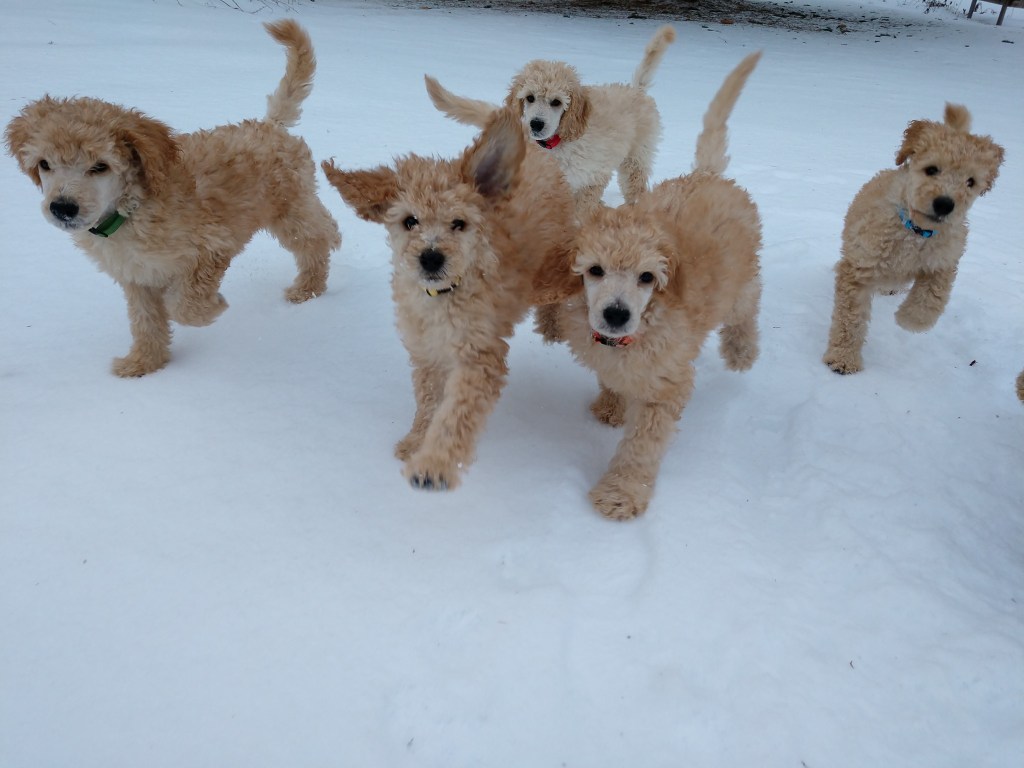
Recalls (coming when called) are one of the most critical and useful behaviors a person can teach their dog, right next to the cued behavior of stopping and waiting. As such, I spend a lot of time practicing recalls with my dogs, starting my litters of pups with solid recalls, helping my puppy homes trouble-shoot if their recall isn’t solid, and generally pondering what a reliable recall is to me and ways to go about teaching it.
Let’s define a Reliable Recall.
Reliable (adjective) – consistently good in quality or performance; able to be trusted. (Definition from Oxford Languages)
When applying this to a recall (“Fido, come!”), it’s crucial to understand that coming when called is a ‘plain old recall’ – almost every dog even without any training has a recall when they feel like coming. What makes it Reliable is that the dog will do it when cued even if they don’t want to.
A truly reliable recall means the dog will stop whatever they are doing and come when called:
- even if they are eating something they shouldn’t
- even if they are greeting another dog
- even if they are chasing a squirrel
- even if there is someone at the door
- even if they know it’s bath-time
If a dog doesn’t respond promptly in all situations you have trained for, then you know there are situations for which you haven’t trained where they will not respond promptly either. This means their recall is Not Reliable.
It’s fine to not have a reliable recall, as long as you acknowledge that fact and use management as needed for safety. Don’t trust your dog to be reliable in the face of a random happenstance, if you haven’t trained for reliability in countless other challenging scenarios. Assess the risks you are comfortable taking and be aware of the dangers in a given scenario before you un-clip that leash.
Types of risks to consider before removing the leash:
- temperament; is your dog naturally inclined to roam or ignore you, do they bolt if startled?
- wildlife; prey to chase, predators who could harm now or if lost for an extended period
- traffic; roads, railways, pedestrians on bikes, etc
- terrain; woods, cliffs, rivers, etc
- size of containment; any fences or natural boundaries (rivers, etc), or could they travel miles in any direction
- population; will others see/help them, or is there no one to call in sightings?
- temperature/season; does heat or cold make survival challenging if lost for multiple days? Hunting season for anything a dog could resemble?
- health condition; medications needed, special diet, heat cycles – anything that impacts their survival abilities if untreated
- time; if they run off, do you have hours or days to seek them? (Local vs traveling, other major commitments, health, finances)
- injury; if they become injured, even if you can get them to a vet quickly, do you have the funds to help them? Is it worth taking the risk?
Types of safety measures to consider using:
- Leash/long line/retractable leash
- Fence/pen/natural barrier (bushes, lake, etc)
- Remote collar (shock/vibrate/beep)
- Bell/reflector/light on collar or harness
- GPS tracking collar/harness
- Microchip in case lost and found without a collar/tag
- Always crate train to teach that a crate or pen is a good, safe place to go in case one needs to be set out to help catch them
What do I personally do?
I may be a pretty decent dog trainer, but I live on a busy road and our main yard is not fenced. I trust only some of my dogs to come when I call them, every time, even when they see a bunny in the yard or dog across the street. Most of my dogs (and nearly all of my dogs during adolescence from around 5-18 months) do not get to run off-leash in our yard unless my full focus is on them, and we have a strong history of highly-rewarded recalls including calling off of major distractions. Even so, I add in some simple ‘test’ cues (sit, stay, nose-touch, etc) throughout our walk to be sure that they are in a Listening Mood, and if they choose not to respond at any point that’s my cue to put the leash back on and not risk waiting for a distraction they won’t call off of. My dogs are all microchipped just in case, but at home I don’t use collars/tags because the risk of injury by getting caught in play or on crate/fence is higher than the risk of them getting loose and not coming when called.
Tips to Build A Reliable Recall
- Reward every recall! You can use any reward your dog likes, and you can occasionally delay it briefly after your dog comes (as in a competition recall), but you *must* praise, play socially, give a treat, toss a ball, play tug – something your dog enjoys.
- Never chase your dog – encourage them to chase you! Walk backwards while clapping your hands enticingly and calling in a happy tone, or turn and actually run away, casually calling your dog to join the fun game. Play and hug them when they catch you, and then take off again.
- Play hide and seek. In a safe area play with them and then wait until they take their eyes off of you, then duck behind a chair/tree/corner and joyfully call out their name; when they turn and don’t see you they will start to look, and you can use your voice to encourage them as needed – very quickly they will learn the game and will eagerly find you without any help needed.
- Train around distractions, and initially control the environment (leash, fence, etc) to prevent your dog from ‘checking out’ the distraction. If there is a treat on the floor and you call your dog, they need to come without getting a chance to sniff the treat… if they sniff it and determine they didn’t really want it, then it’s no longer a distraction – it’s just a thing they don’t care about.
- Don’t poison your cue! Pick a cue for your recall and never use it except when you actually will follow-through to make a recall happen. Pick a different word for your casual ‘come over this way’ cue. I use “come” to mean ‘run to me quickly and let me hold your collar’; “here” to mean ‘bring your nose to my hand’ (I also use “front” to mean ‘come directly to me and sit in front of me’ as in the obedience ring, and ‘”closer” to mean ‘move closer to me’, and their name to mean informally to come to me and be attentive).
“Fido, Come – Cookie!”
How many times have you resorted to bribing your dog to come by using a magic phrase like “cookie”, “want a treat?”, “where’s your ball?”, “let’s go for a ride!”, “wanna go for a walk?” or “Daddy/Mommy’s home!”? Why do you think that phrase works? It’s probably because you’ve unintentionally but very thoroughly taught it to mean that happy thing is a definite and it’s happening now. When you say ‘cookie’ it’s because you are giving one now or on your way to get one – your dog doesn’t know the dictionary definition, only what you’ve helped them associate the sound to mean. When you say ‘want to go for a walk?’ you are getting up to get the leash to head out for an adventure. When you say “Daddy’s home!” it’s because Daddy has just pulled in the driveway and any second your dog will hear him step onto the porch and open the door, ready for a happy greeting.
Treat your recall cue with the same amount of reliability and half the work of teaching it will already be done.
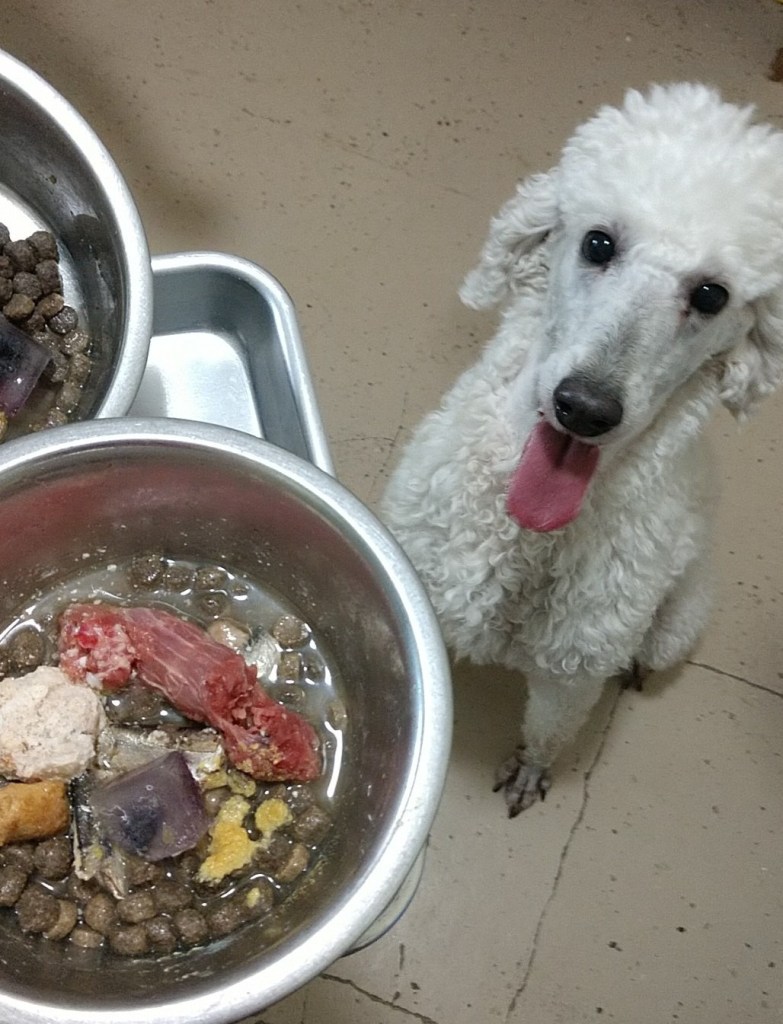
Try this: pick a new word you’ve never used as a cue before and rarely use in daily life; “pickle” perhaps, or “brickwall” – just pick something with a unique ring to it. Don’t do anything special as far as training goes, just say this word every time you give your dog a delicious treat. Before you know it your dog will come running when they hear this word.
As an experiment, I’ve raised multiple dogs without using the word “come” except as a literal replacement for times I would typically say “cookie”. “Come” as I’m giving out treats. “Who wants a come?” when I’m on my way to open a bag of treats. On testing the word out in the yard, those dogs ran to me just as quickly and happily as the dogs who had been taught an actual recall to the word “come”.
I hope this article has given you something to think about, and encourages you to test your recall in safety and maybe try out some of these tips if you find that you’d like to increase your dog’s reliability. My upcoming article goes hand-in-hand with this one, bringing you tips for simply teaching your dog reliable off-leash obedience skills.
Click the links below to check out my other posts, and add your email below if you’d like my future blog posts to be sent to you directly.
 APAW - Poodle Pups for Working Roles
Leave a comment